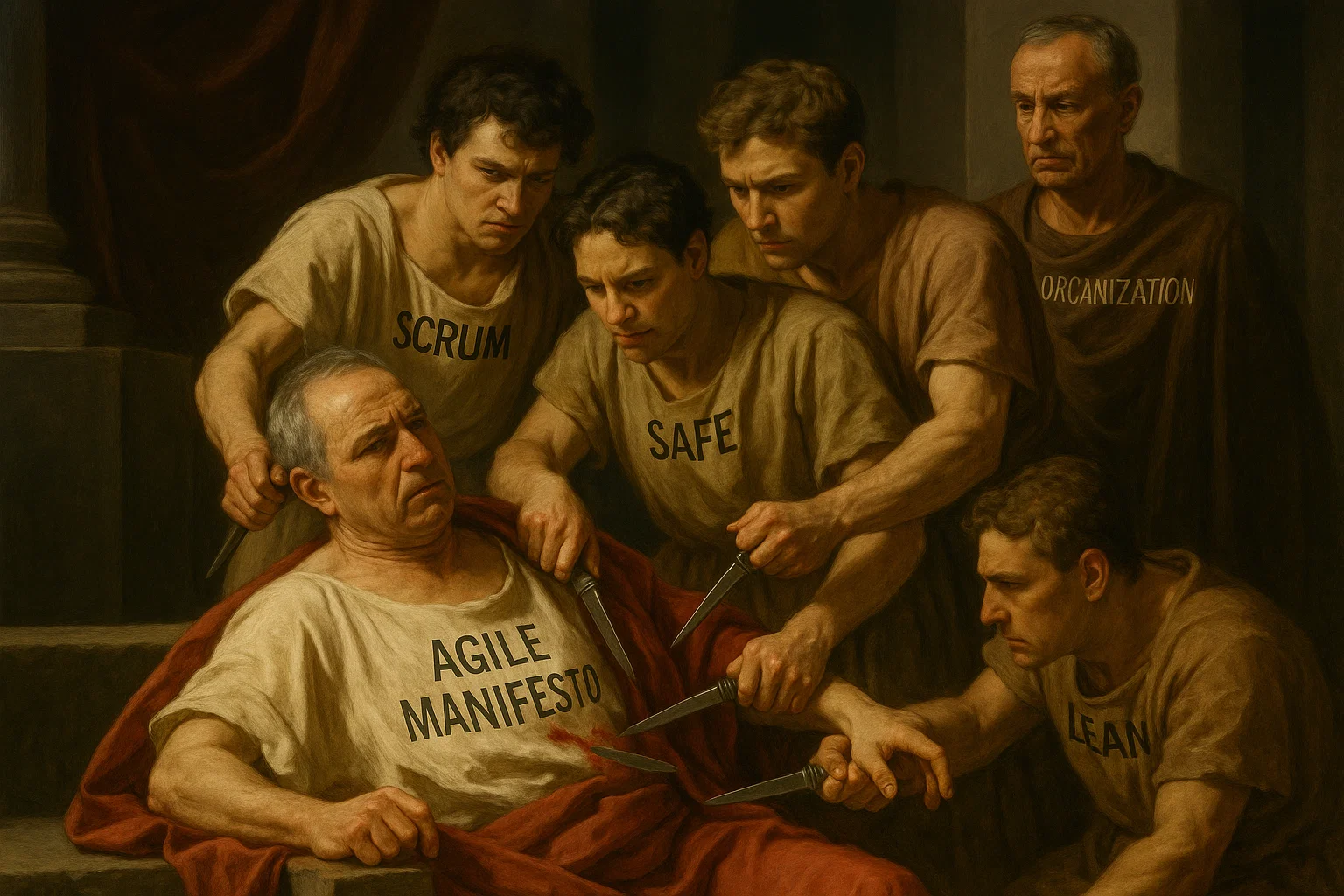
Once upon a time (Feb 2001, around 25 years ago), Agile manifesto arrived as the superhero in cape for software development: promising speed, adaptability, and a razor-sharp focus on what customers actually wanted.
While Agile’s soul was anti-framework, yet, in the winding corridors of enterprises, marred by the fear of chaos, the fear of losing control, its cape have been snagged on the rigid hooks of frameworks like Scrum and SAFe, transforming Agile into what? a “veiled Waterfall” ?
This evolution is tragically ironic and immensely detrimental for the exciting field of Artificial Intelligence (AI), where true flexibility is as critical as breathing.
Enterprises’ fear of chaos and losing control
Agile wasn’t a method; it was a mindset
It was a way of work, rooted in the visionary Agile Manifesto. The core idea was to put people and interactions first—way ahead of processes and tools.
But guess what? Enterprises with their inherent fear of chaos and losing control seem terrified of embracing this. Understandably, its hard to let go of the steering wheel, where trust is fragile.
- Power Distribution Dread: Leaders often shudder at the thought of spreading decision-making power, like butter too thin on toast. It’s comforting to retain a top-down, command-central structure, which is sadly at odds with Agile’s self-organizing teams.
- Control Loss Anxiety: There’s a haunting fear of progressing without strict processes—no safety net! Enterprises tend to cling to outputs arising out of predictable structure and processes, like a comfort blanket, afraid of Agile’s inherent risks and dynamism.
- Scrum and SAFe’s Role: Advertised as the pathways to agile success, they became the tools of control, in veil of implementing Agile.
Scrum and SAFe: When Agile Becomes a Rulebook
In reality, SAFe and a stringent application of Scrum often betray Agile’s core ethos. They morph into “new Waterfall” models draped in Agile clothing, prioritizing structured processes over fundamental principles.
The Agile Manifesto Betrayed
-
Delivering Worth Real Fast: Agile at its heart is about ==frequent delivery of valuable software==. While SAFe might introduce a continuous delivery pipeline, the behemoth-like scale often reshifts focus—not on genuine customer value but on ==completing “Program Increment” cadences==. It’s like focusing on cooking process without tasting it, or get it tested by the consumer.
-
Change is Not Always Welcome: Agile rolls out the ==welcome mat for changes==, even fashionably (or sometimes unfashionably) late in development. Yet, under Scrum’s guise of “sprint stability,” teams may ==hide behind rigidity, resisting change==. SAFe’s robust rulebook can further encumber swift pivoting. Static is the enemy of AI.
-
In Trust We Trust? Agile is about ==empowering teams to innovate and deliver==. Nonetheless, SAFe ==centralizes the power,== devolving project teams into execution drones rather than masterminds of creativity. Trust is eroded, curbing autonomy and, ultimately, success.
The Dreadful Impact on AI Development
Talking about AI: this is a universe that thrives on uncertain exploration, brisk iteration, and ever-shifting objectives. Rigid frameworks just won’t do!
- Navigating Uncertainty and Experimentation: AI, especially in data science, requires constant tinkering and evolving due to the unknowns and potential seismic shifts data can bring.
- Faster, Faster, Faster!: AI feeds on rapid feedback and brisk refining of models. With tools accelerating cycles, adapting becomes essential—think quick silver, not molasses.
- Shapeshifting Requirements: As stakeholders grasp AI’s potential, the need for regular reshaping arises, yet outdated frameworks put on the brakes.
Through a rigid, software-centric Scrum or SAFe lens, AI faces hurdles:
- Sprint Stagnation: Fixed sprints and release cycles clash with AI’s unpredictable workflow, where data-prompted shifts are the norm, not the exception.
- Overcooked Planning: Prescriptive, exhaustive planning stifles the crucial iterative discovery process AI demands.
- Micromanagement Misfit: Rigid frameworks foster micromanaging—a creativity killer. AI needs wild brainstorms, not restrictive oversight.
- Processes Over Purpose: Following processes can pivot from delivering meaningful value, a deterrence to AI’s required velocity and impact.
As a RAND Corporation study highlighted, rigid interpretations of agile processes are often a poor fit for many AI projects, potentially impeding success rather than fostering it. The study underscored that data exploration and experimentation in AI frequently demand more flexible and extended timelines than traditional agile methods allow. These frameworks, against which Agile originally stood, are now holding us back, particularly in this critical new frontier.
Rediscovery Through Agility’s True Spirit
Agile is a mindset, not just an array of frameworks like Scrum or SAFe.
- Rigidity dilutes genuine agility.
- Agile is about trust, empowerment, embracing change, and valuing delivery over rote procedure.
To unleash AI’s magic, a return to basics is necessary, ==focusing on overcoming cultural inertia rather than indulging it==.